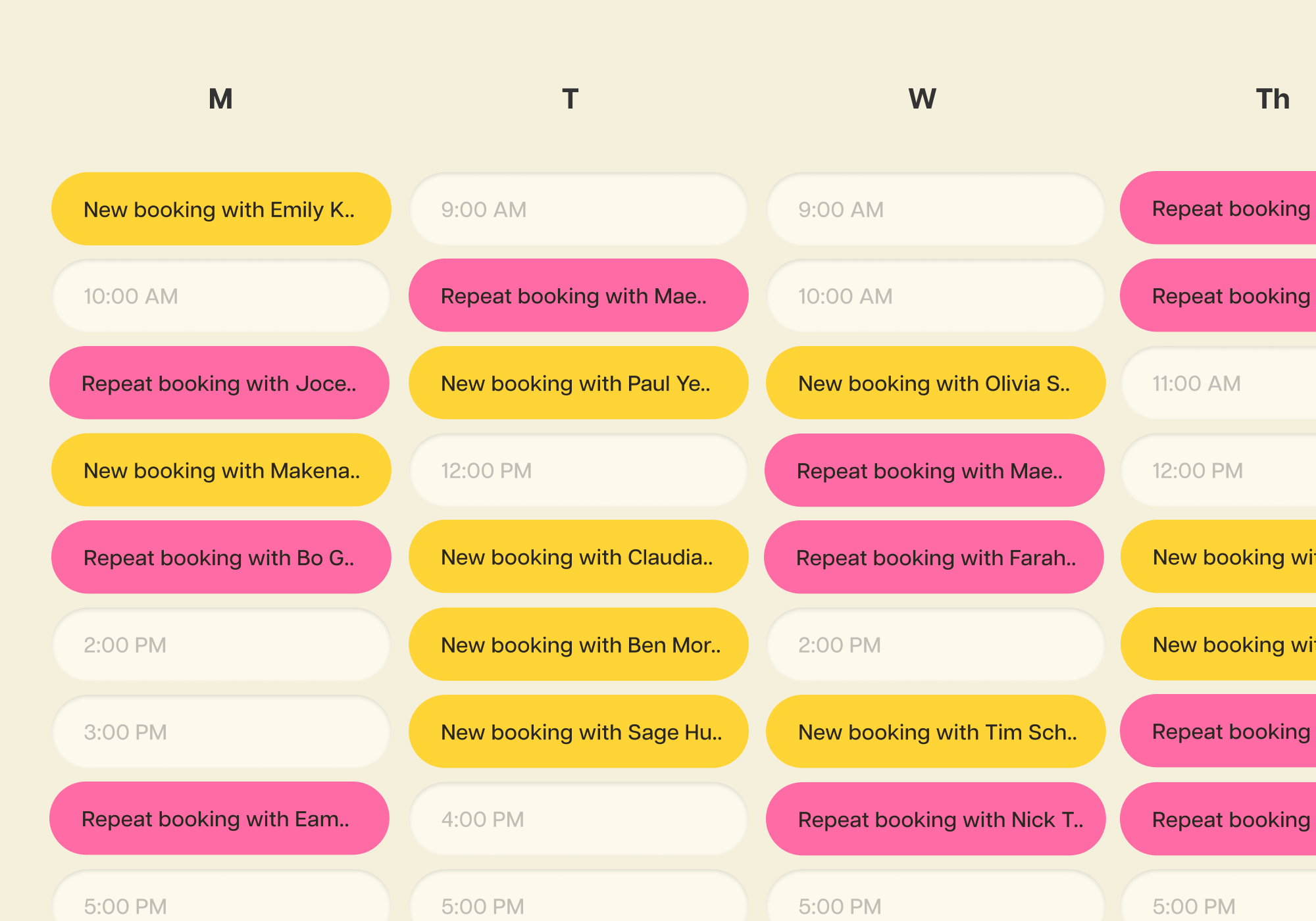
In mental healthcare, patient retention is supposed to be the ultimate win-win. When a patient stays in clinically appropriate care, they achieve better outcomes (win) and your practice secures recurring revenue to fill its schedules and fuel long-term growth (win).
The strategy for growing a practice is straightforward: attract new patients, keep provider schedules full, and deliver quality care. Keep patients engaged over time, and your average patient lifetime value (LTV) skyrockets.
But there’s a but coming. High patient retention doesn’t translate to sustainable growth if you have to pay a platform booking fee on every single session.
Nearly seven in 10 patients search for a provider in multiple places. To grow your patient panel and ensure provider schedules stay full, mental health practices need to be bookable everywhere patients look: across search engines, insurance directories, AI chat, apps and consumer sites, and more.
But when platforms charge for every follow-up visit, scaling multi-channel patient volume penalizes your bottom line.
There’s a big difference between paying a single fee to discover a new patient and paying an ongoing “therapy tax” on patient relationships you maintain over time.
The long-term economics of practice growth
A patient seeing a dermatologist or visiting urgent care might book one or two visits a year. Behavioral health doesn’t work that way. Care is inherently multi-session, routine, and long-term. Zocdoc data shows that psychologists generate 3.3x and psychiatrists 4.5x the rebookings of baseline medical specialties.
When you combine a high-rebooking specialty and model where you only pay once to acquire a new patient, the financial return for your practice can compound rapidly.
Because behavioral health clients return frequently, mental health practices tend to recover their initial discovery fee much faster than Zocdoc’s platform average of two months. And with initial acquisition costs recouped early, a single new patient in your panel can generate an ROI far higher than Zocdoc’s platform average of 8.16x.
Calculating lifetime value (LTV)
To understand what platform fees truly cost you, you have to look at annual net LTV: your yearly income from a patient after factoring in operational friction (cancellations and uncollected claims) minus your patient acquisition cost.
Under a model where you pay only the first time a new patient discovers you, acquisition cost is a fixed, one-time investment paid off early. A per-session model fundamentally changes the math by turning acquisition into an ongoing expense.
Consider a client completing 20 sessions over a year at a $100 average reimbursement. Factoring in a sample 85% collection rate (accounting for no-shows and claim denials), your practice collects $1,700 in revenue.
- On a platform that charges a recurring fee per session (for example, $10 fee/visit): You pay $10 on every visit. Over 20 sessions, your platform cost is $200. This leaves your practice with $1,500 in annual net LTV.
- On a platform that charges a one-time new patient discovery fee and $0 rebooking: You pay a single discovery fee upfront (for example, $75). There is no fee for follow-up visits. This leaves your practice with $1,625 in annual net LTV.
On a single patient, that is $125 back in your pocket. Across a panel of 150 patients, a per-session booking fee drains over $18,750 annually from your practice.
Finding fit: The real driver of long-term value
As mental health practice leaders well know, realizing high patient lifetime value is much more than a math equation. It depends heavily on therapeutic fit. Behavioral health clients stay in care when they build rapport and feel aligned with their provider’s clinical approach.
“Finding a mental health provider is a high-consideration decision that takes time,” explains Kate Wulfson, Director of User Research at Zocdoc. “On the surface, patients look at logistics like insurance coverage and immediate availability. But beneath the surface, they are searching for deep clinical fit, rapport, and identity alignment.”
Not surprisingly, finding the right mental health provider is an overwhelming, multi-stop journey, or what Wulfson’s team calls a “painful game of chutes and ladders.” Outdated insurance directories, surprise out-of-network fees, and vague provider profiles force patients to start and stop care, restarting their search repeatedly.
Removing search friction, fueling retention
Building durable patient relationships requires clarity, transparency, and support. When patients can access detailed provider bios, ample reviews, real-time calendar availability, and verified insurance verification upfront, they gain the confidence to make an informed choice on which provider is the right fit for them.
Mental health searchers on Zocdoc evaluate over 30 provider profiles on average before selecting a clinician. Supported by upfront transparency, that deliberate research yields remarkable engagement: 70% of behavioral health patients remain with the same provider after starting treatment.
When seamless patient discovery comes with no rebooking fees, patient retention becomes what it was always meant to be: a win for patient outcomes and a win for your practice’s long-term sustainability.
Learn more about growing your practice with Zocdoc.